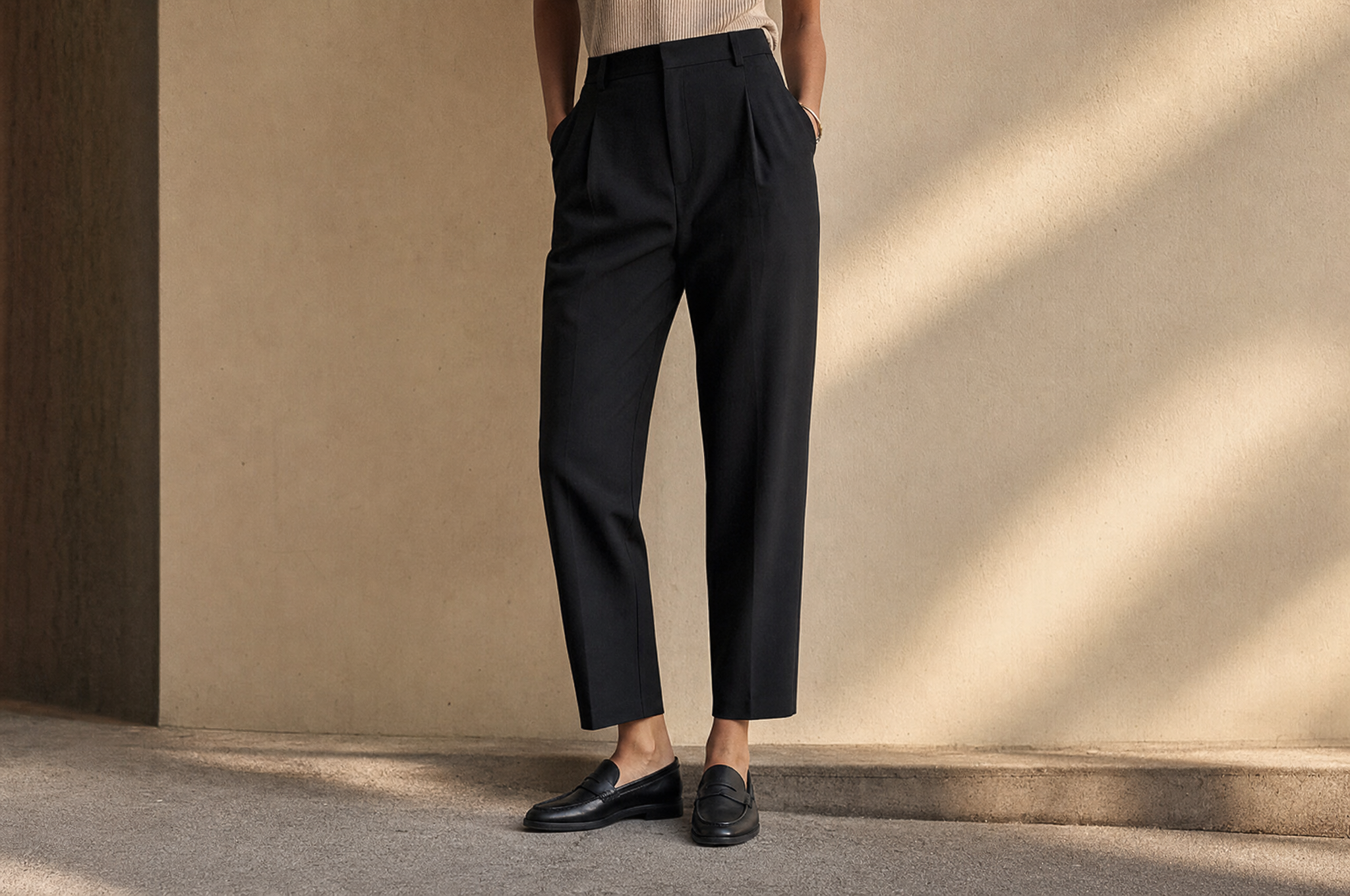
If I had to identify the single most common fit problem in women's trousers — the one issue that affects more women than any other, that ruins more outfits than any other, and that's easiest to fix — it would be this: the wrong inseam.
Most women are wearing trousers that are too long. A significant minority are wearing trousers that are too short. Almost no one is wearing trousers that are exactly the right length. And here's the thing that makes this so frustrating: it's the one fit variable that's entirely objective, entirely measurable, and entirely fixable. You don't need a tailor's eye to get it right. You need a tape measure and five minutes.
Let's fix this right now.
What Is an Inseam?
Your inseam is the measurement from your crotch seam to the bottom of your ankle bone (or to wherever you want your trouser hem to end). It's the length of the inner leg — the measurement that determines where your trousers fall on your foot or ankle. Every pair of trousers has an inseam, and every body has an inseam, and the two need to match for the trousers to fit.
Simple enough. And yet, here's why it goes wrong: most trousers are manufactured to a standard inseam that fits almost no one.
The standard inseam for women's trousers is 30 inches for regular sizes, 28 inches for petite, and 32-34 inches for tall. But the average woman's actual inseam varies enormously depending on her height, her proportions, and the rise of the trousers she's wearing. A woman who is 5'5" might have an inseam of anywhere from 27 to 30 inches depending on how her height is distributed between her torso and her legs. The "regular" 30-inch inseam is a compromise that fits the statistical average — which is to say, it doesn't actually fit anyone perfectly.
The fashion industry sizes trousers to a statistical fiction. Your body is not a fiction. Measure it.
How to Measure Your Inseam
Here's the method. You'll need a soft measuring tape and a pair of trousers that fit you well through the rise (the crotch seam sits in the right place).
Method 1: Measuring from a Trouser
- Find a pair of trousers that fit you well — not too tight, not too loose, with the crotch seam sitting comfortably where it belongs.
- Lay the trousers flat on a table or the floor, smoothed out so there are no wrinkles.
- Measure from the crotch seam (the point where the four seams meet in the center) straight down the inner leg to the bottom of the hem.
- That number is your inseam.
This method works because it measures a garment that already fits you, which accounts for your actual body proportions. It's the most reliable approach.
Method 2: Measuring Your Body
If you don't have a pair of trousers that fits well, you can measure your body directly:
- Stand barefoot with your feet shoulder-width apart.
- Have a friend (or use a mirror) measure from the very top of your inner thigh, at the crotch, straight down the inside of your leg to your ankle bone.
- That number is your approximate inseam for full-length trousers.
Method 2 is less precise than Method 1 because it doesn't account for the rise of the trouser, but it gives you a starting point. If you're between sizes, round to the nearest half-inch.
Inseam and Break: The Two Decisions
Knowing your inseam is only half the equation. The other half is deciding on the break — how you want the trouser to meet your shoe. Your inseam measurement tells you the raw number; your desired break tells you how to adjust it.
Here's how it works: your ideal trouser inseam is your body's inseam measurement plus or minus a small amount depending on the break you want:
- No break (modern, sharp): Trouser inseam = your inseam. The hem just touches the top of your shoe. No fold, no pooling. Clean and contemporary. This is the standard for tapered trousers.
- Half break (classic, versatile): Trouser inseam = your inseam + 1 inch. The hem rests on the shoe with a moderate fold. The most common choice for straight-leg and tailored trousers.
- Full break (formal, traditional): Trouser inseam = your inseam + 2 inches. The hem extends past the heel and creates a deep fold on the shoe. Classic and conservative. Best for formal wool trousers.
- Cropped (intentional): Trouser inseam = your inseam - 2 to 4 inches. The hem ends above the ankle. See our guide to cropped trousers for when and how to wear this.
So if your inseam is 29 inches and you want a half break on a straight-leg trouser, you need trousers with a 30-inch inseam. If you want no break on a tapered trouser, you need 29 inches. If you want a cropped look, you need 25-27 inches. The measurement is the foundation; the break is the styling choice built on top of it.
Why Height Isn't Enough
Here's a common mistake: assuming that your height determines your inseam. It doesn't — or rather, it does, but only approximately. Two women who are both 5'6" can have inseams that differ by two inches or more, because height is distributed differently between the torso and the legs.
A woman with a long torso and shorter legs at 5'6" might have a 28-inch inseam. A woman with a short torso and long legs at the same height might have a 30-inch inseam. Same height, different inseam, different trouser size needed. This is why buying trousers based on height alone — or based on the "regular" size — so often results in a poor fit.
It's also why rise matters. Two trousers with the same inseam but different rises will fit differently — the higher rise effectively shortens the inseam because the waistband sits higher on the body. A 30-inch inseam on a high-rise trouser will be longer on the body than a 30-inch inseam on a low-rise trouser. If you're switching between rises, you may need to adjust your inseam accordingly.
Common Signs You're Wearing the Wrong Inseam
Too Long (the most common problem)
- The fabric pools or bunches at the ankle, creating a messy stack of folds.
- The hem drags on the ground when you walk, causing fraying and damage.
- The trouser looks like it belongs to someone taller than you.
- You find yourself constantly rolling or cuffing the hem.
- The break is so deep that it creates a horizontal line across the front of your shin, visually shortening your leg.
Too Short
- The hem sits above the ankle bone when you're standing (unless it's intentionally cropped).
- You can see your socks or a significant amount of bare leg when you sit down.
- The trouser reads as "high-water" — it looks like you've grown out of it.
- There's no break at all on a full-length trouser — the hem floats above the shoe.
The Fix: Tailoring
Here's the good news: the wrong inseam is the easiest fit problem to fix. A tailor can hem trousers for $15-30, and the process takes less than a week. There is no excuse for wearing trousers that are too long when a hem costs less than a cocktail.
When you take trousers to be hemmed, tell the tailor exactly what you want. Don't say "just hem them." Say "I'd like a half break" or "I'd like the hem to just touch the top of my shoe." Better yet, bring the shoes you'll wear with the trousers to the fitting. The tailor should mark the hem while you're wearing the shoes, because the height of the shoe affects where the break falls.
Never trust a tailor who hems without asking about your shoes. The break depends on the shoe. Always.
What About Letting Down?
If your trousers are too short, the fix is harder. Most trousers have only 1-2 inches of extra fabric folded under the hem — the "let-out" allowance. A tailor can let this down to add length, but after that, there's nothing more to be done. This is why it's better to buy trousers slightly too long (which can be hemmed) than slightly too short (which often can't be fixed).
Inseam by Silhouette
Different silhouettes call for different inseam approaches:
- Wide-leg trousers: Long. The hem should graze the top of the foot or kiss the floor. A wide-leg that's too short looks truncated and awkward.
- Tapered trousers: Shorter. No break or a very slight break. The narrow leg opening should sit cleanly at the ankle.
- Straight-leg: Medium. Half break is classic; no break is modern. Either works.
- Palazzo pants: Very long. The hem should reach the floor. Fluid fabric needs length to drape properly.
- Cropped trousers: Intentionally short. The hem should hit 1-3 inches above the ankle bone, at the narrowest part of the ankle.
The Ripple Effect
Here's why getting your inseam right matters more than you might think. The wrong inseam doesn't just affect the hem — it affects the entire perception of your proportions. Trousers that are too long make you look shorter because the pooling fabric creates a horizontal break that cuts the vertical line. Trousers that are too short make your legs look shorter because they end abruptly before the foot.
Get the inseam right, and suddenly everything else works better. Your legs look longer. Your shoes look intentional. The overall proportion of your outfit feels balanced. It's the fit adjustment that has the biggest impact for the least effort.
If you're building a trouser wardrobe, getting your inseam right is step one. Before you buy another pair of trousers, measure your inseam. Write it down. When you shop, check the inseam listed on the retailer's website. If it's not listed, ask. And when you buy, budget for tailoring — because even if you find the right inseam off the rack, you'll still want the hem adjusted for your specific shoe height and preferred break.
The Bottom Line
Your inseam is a number. It's a fact about your body that doesn't change, that's easy to measure, and that determines more about how your trousers fit than any other single variable. Knowing it transforms how you shop, how you dress, and how you feel in your clothes. It takes five minutes to measure and it changes everything.
So go find a tape measure. Right now. We'll wait.