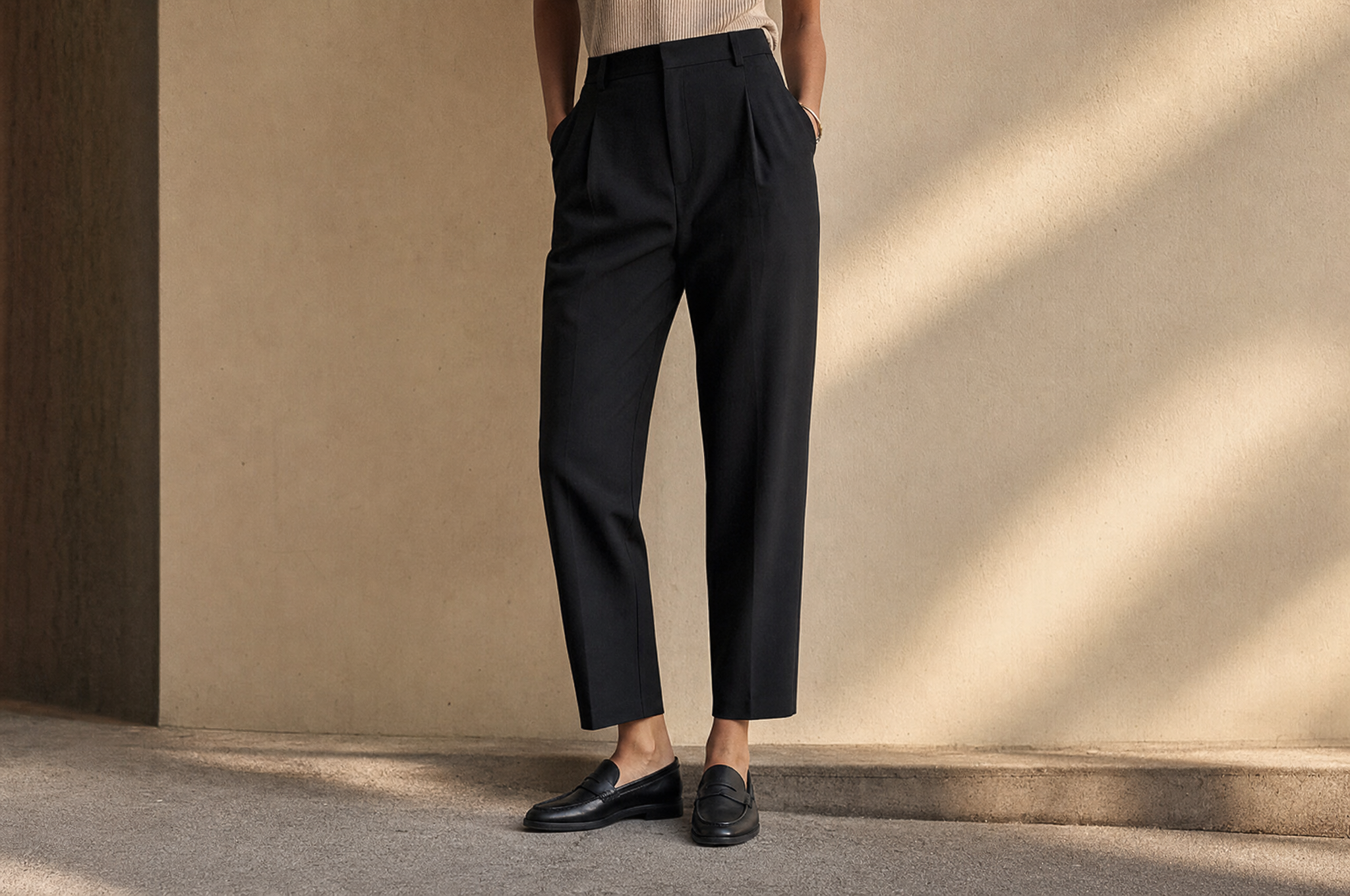
Stand in front of a rack of trousers and try to tell the tapered from the straight. Unless you're holding them side by side and examining the cut, you probably can't. They look the same. They hang the same. They're often in the same section, made by the same brand, in the same fabric. A sales associate might describe them as "similar cuts."
They are not similar cuts. And the difference — which becomes obvious the moment you put them on — determines everything about how the trouser looks on your body, what shoes you can wear with it, and whether it flatters your particular proportions. This is a comparison worth understanding.
The Defining Difference
Here's the core distinction, stated as simply as possible: a straight-leg trouser maintains the same width from hip to hem. A tapered trouser narrows from the knee (or high thigh) to the ankle.
That's it. That's the difference. But that single change in how the fabric is cut creates two entirely different garments.
To understand why, we need to talk about what happens to fabric when it changes width as it falls.
Straight-Leg: The Architecture of Consistency
How It's Cut
A straight-leg trouser is cut so that the circumference at the hip is essentially the same as the circumference at the knee and the ankle. The fabric falls in a straight, continuous line from the widest part of your hip to the floor. There's no narrowing, no widening — just a clean, vertical column.
How It Looks On The Body
Because the fabric maintains its width all the way down, a straight-leg trouser creates a long, unbroken line. This has several effects:
- It elongates the leg. The continuous line from hip to hem draws the eye downward without interruption, making legs look longer.
- It's forgiving. Because the fabric doesn't narrow, it doesn't cling or pull at any point. It skims the body without hugging it.
- It's classic. The straight-leg has been a wardrobe staple for decades because it works on virtually every body type and reads as timeless rather than trendy.
The straight-leg is the baseline — the cut against which all other silhouettes are measured. If you're not sure what will work, start here.
The Break
With straight-leg trousers, the break — how the hem meets your shoe — matters enormously. Because the leg opening is consistent (typically 15-17 inches in circumference), the fabric pools or breaks on your shoe in a specific way.
- Full break: The hem extends past the heel and creates a deep fold on the top of the shoe. Classic, formal, slightly conservative.
- Half break: The hem rests on the shoe with a moderate fold. The most versatile and most common choice.
- No break: The hem just touches the shoe, with no fold. Modern and sharp — shows a sliver of sock or ankle.
Your choice of break changes the entire character of the trouser. Understanding your inseam is essential for getting the break right.
Tapered: The Architecture of Direction
How It's Cut
A tapered trouser is cut with more room through the thigh and hip, then narrows from the knee (or sometimes the high thigh) down to the ankle. The leg opening is significantly smaller than the hip — typically 12 to 14 inches in circumference. The fabric is cut on an angle, creating a silhouette that's wider at the top and narrower at the bottom.
How It Looks On The Body
The narrowing creates a different visual effect:
- It defines the leg. Unlike the straight-leg's continuous line, the tapered trouser draws attention to the shape of the leg. The narrowing from knee to ankle creates a sense of structure and definition.
- It's modern. The tapered silhouette reads as contemporary and intentional. It's the cut of someone who knows what they're doing.
- It shows the shoe. Because the leg opening is smaller, the tapered trouser sits closer to the ankle, putting your shoes on display. This is both an advantage (great shoes get noticed) and a constraint (mediocre shoes can't hide).
The Break (or Lack Thereof)
Tapered trousers are typically worn with no break or a very slight break. Because the leg opening is narrow, a full break would create bunching that looks sloppy rather than classic. The ideal tapered trouser hem sits just at or slightly above the ankle bone, creating a clean line that ends crisply.
This is why tapered trousers are often worn cropped — the combination of taper and crop is natural and flattering. The narrowing draws the eye to a clean endpoint rather than a pooled hem.
Visual Comparison: Side by Side
| Feature | Straight-Leg | Tapered |
|---|---|---|
| Hip to Hem | Consistent width | Narrows from knee |
| Leg Opening | 15-17 inches | 12-14 inches |
| Visual Effect | Elongating, clean line | Defining, structured |
| Best Break | Half break | No break |
| Shoe Visibility | Partially covered | Fully visible |
| Overall Feel | Classic, timeless | Modern, intentional |
| Best For | Most body types | Defined legs, narrow ankles |
Which Works For Your Body?
If You're Petite
Go tapered. The narrowing creates a sense of length that the straight-leg can't achieve on a shorter frame. Pair with a high rise and a heel, and you've maximized your vertical line.
If You're Tall
Either works. Tall frames can carry both silhouettes beautifully. The straight-leg will look classic and elegant; the tapered will look sharp and modern. Choose based on the occasion and your personal style.
If You Have Athletic or Muscular Legs
Go straight. The tapered cut can emphasize the contrast between a muscular thigh and a narrow ankle. The straight-leg creates a more balanced, continuous line that's more flattering on athletic builds.
If You Have Slim Legs
Either works, but tapered can add definition. The narrowing can create the illusion of shape and structure. A straight-leg will look clean and elegant but might not create the definition you want.
If You're Curvy
Go straight. The consistent width of a straight-leg skims curves without clinging. A tapered trouser can create an unflattering contrast between the hip and ankle. If you want a tapered look, choose one that starts from a roomier hip and tapers gradually.
Styling Differences
The two cuts also style differently. Here's the quick guide:
Straight-leg trousers pair well with most shoes: flats, heels, boots, loafers. Because the leg opening is moderate, the shoe is partially visible but not the focal point. This makes straight-leg the more versatile choice for everyday wear.
Tapered trousers put your shoes on full display. This is an opportunity (great shoes get noticed) but also a constraint (worn-out shoes can't hide). Pointed-toe flats, sleek heels, and ankle boots all work beautifully. Chunky sneakers or heavy boots can create a jarring contrast with the narrowing leg.
For tops, both cuts work with tucked-in blouses, cropped sweaters, and fitted knits. The straight-leg is more forgiving with longer, untucked tops because the continuous line doesn't fight the volume. The tapered benefits from a defined waist — tuck or crop to show the contrast between the roomier hip and the narrowing leg.
Where They Fit in Your Wardrobe
If you're building a trouser wardrobe, both cuts have a place. The straight-leg is the classic workhorse — the pair that works everywhere and never looks wrong. The tapered is the modern counterpart — the pair that looks intentional and current.
Most women benefit from having one of each: a straight-leg in wool for the office and formal occasions, and a tapered pair in a lighter fabric for more modern, everyday looks. Together with a wide-leg for statement moments and a cropped pair for versatility, you've covered the full range of trouser silhouettes.
The key is understanding what each cut does — not just what it looks like on the rack. Once you can see the difference, you'll never confuse them again. And you'll never buy the wrong one for your body.