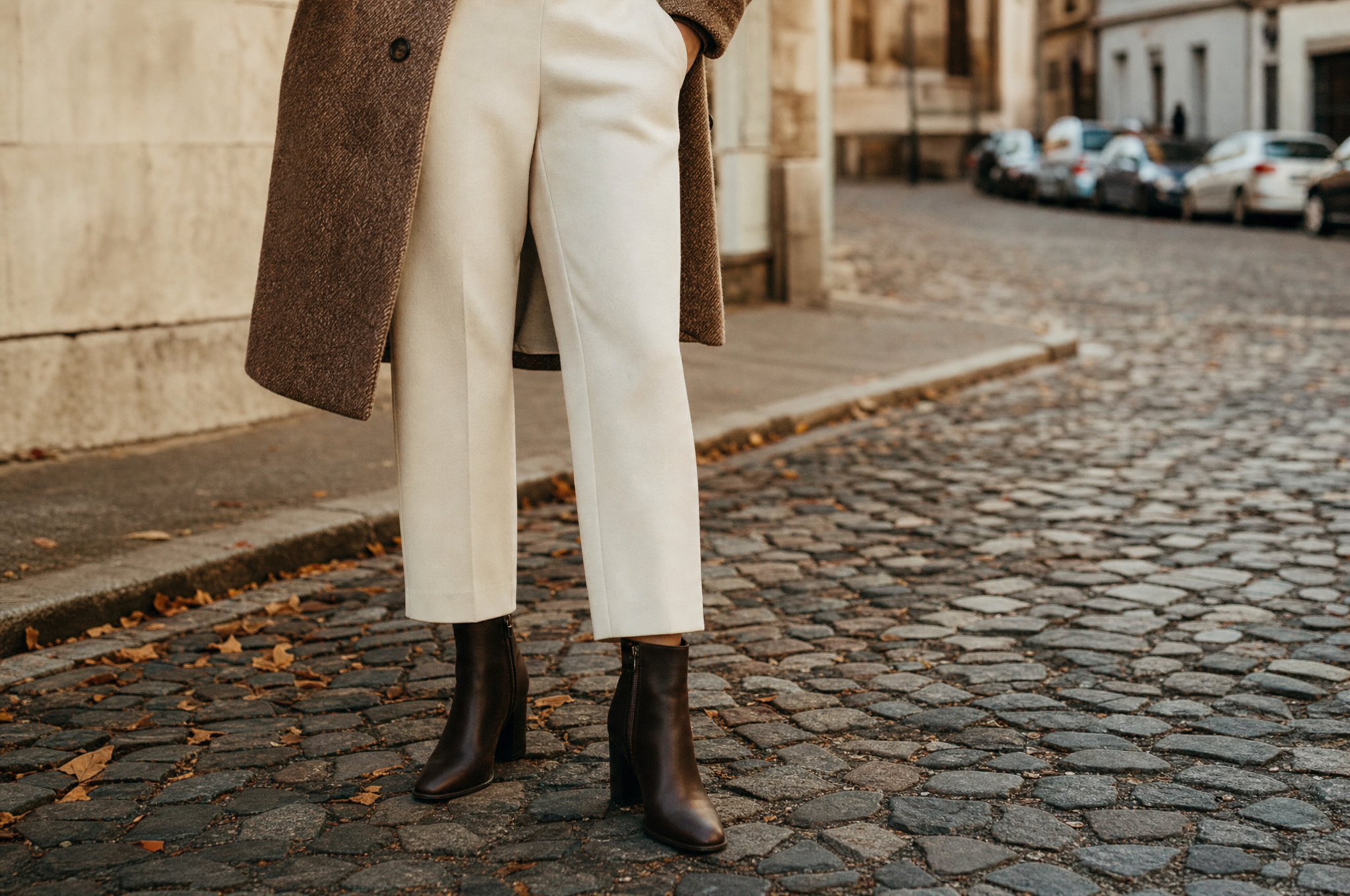
It happens every November. The temperature drops, the boots come out, and the cropped trousers — those versatile, perfect-for-everything ankle-skimming pants you wore constantly from March through October — get pushed to the back of the closet. It feels like the seasons have made the decision for you. Ankle pants are for warm weather. Winter requires full coverage. Case closed.
But the case isn't closed. It's barely been examined. The truth is that cropped trousers can be one of your best winter garments — if you know how to layer them. The issue isn't the length; it's the gap. That two-to-four-inch space between the hem and your shoe, which is a styling asset in summer, becomes a vulnerability in cold weather. Close the gap, and the cropped trouser becomes a year-round workhorse.
Here are five strategies that actually work. No shivering required.
Strategy 1: The Tall Boot Bridge
This is the most elegant solution, and possibly the simplest. Pair your cropped trousers with tall boots — knee-high or over-the-knee — that fill the gap between hem and foot. The trouser sits either over the boot shaft or tucks neatly inside, creating a continuous line from waist to toe with no exposed skin.
The beauty of this strategy is that it preserves the proportion of the cropped trouser while eliminating its winter weakness. The crop still hits at the narrowest part of your ankle — it just happens to hit at the top of a boot rather than on bare skin.
What works: Cropped straight-leg or tapered trousers with leather or suede knee-high boots. A low heel keeps it walkable; a higher heel dresses it up. The trouser should meet the top of the boot or overlap slightly — no gap between hem and boot.
The tall boot doesn't just solve the cold problem. It creates one of the most polished winter silhouettes available — tailored, intentional, and completely weather-appropriate.
Strategy 2: The Ankle Boot Alignment
If tall boots aren't your thing (or aren't right for the outfit), ankle boots are your second line of defense. The key here is alignment: the top of the ankle boot should meet or slightly overlap the hem of the cropped trouser. When the two touch, the gap disappears and the look feels intentional rather than seasonally confused.
This requires attention to two measurements: the length of your cropped trousers and the height of your ankle boots. Ideally, you want the boot shaft to rise to at least the same point as the trouser hem. If the boot is too short, you'll have a visible gap of skin — which reads as "I forgot it's January" rather than "I'm styling this intentionally."
What works: Cropped trousers with a boot shaft that reaches 2-4 inches above the ankle bone. A slight heel adds polish and warmth (your foot is further off the cold ground). Avoid booties that hit below the ankle bone — they won't close the gap.
Strategy 3: Opaque Tights Underneath
This is the most versatile strategy, and it opens up possibilities that the boot strategies can't. By wearing opaque tights under your cropped trousers, you can pair them with any shoe — flats, heels, low boots — without exposing bare skin to the cold.
The trick is in the tights. You need opaque — not sheer, not translucent. A 60+ denier tight in a color that matches either your trousers or your shoes creates a seamless line. Black tights under black cropped trousers, worn with black flats, creates a continuous column that's elegant and warm. Nude-for-you tights under lighter trousers are less effective (they can look like you're wearing pantyhose, which reads dated), so stick to darker, denser colors.
What works: Cropped wool trousers in a dark color (charcoal, navy, black) worn over matching opaque tights, with a low heel or flat. The overall look is polished and office-appropriate. This is also the strategy that lets you wear cropped trousers with shoes that wouldn't work in the boot strategies — loafers, oxfords, pointed-toe flats.
The Thermal Upgrade
If you live in a genuinely cold climate, consider thermal tights — opaque tights with a brushed or fleece-lined interior. They're thicker than standard opaque tights, which means they work best under trousers with a bit of room in the leg. A slim straight-leg or slightly relaxed tapered trouser will accommodate thermal tights without looking bulky. A very slim pant might feel too tight over them.
Strategy 4: The Longer Sock
This is the most overlooked strategy, and it's perfect for a casual or weekend look. Wear cropped trousers with ankle boots, and fill the gap with a visible sock that's been deliberately chosen as part of the outfit.
The key word is deliberately. This is not the sock you wore to the gym. It's a ribbed wool sock, a cashmere blend, or a textured knit in a color that complements the outfit. The sock should be tall enough to fill the entire gap between trouser hem and boot top — no skin showing.
This strategy has a specific aesthetic: it's cozy, intentional, and slightly European. It works best with casual cropped trousers — cotton twill, denim, or a relaxed wool — rather than formal tailoring. Think weekend, not office.
What works: Cropped cotton trousers, a chunky ribbed sock in a complementary color (oatmeal, charcoal, sage), and a lace-up ankle boot. The sock should be visible but not overwhelming — an inch or two of texture between hem and boot.
Strategy 5: The Right Fabric
The final strategy isn't about what goes under or over your trousers — it's about what the trousers themselves are made of. If you want to wear cropped trousers in winter, choose winter-weight fabrics.
A lightweight cotton cropped trouser will never feel right in December, no matter how you layer it. But a cropped trouser in wool flannel — brushed, warm, substantial — feels exactly right. The fabric does the insulating work, and the cropped length becomes a styling choice rather than a seasonal mismatch.
Winter-appropriate fabrics for cropped trousers:
- Wool flannel: The gold standard. Warm, beautiful drape, looks expensive. See our wool guide for details.
- Wool crepe: Less warm than flannel but still substantial. Good for milder winter days or heated offices.
- Heavyweight cotton twill: Casual and sturdy. Good for weekends.
- Brushed cotton or corduroy: Casual, warm, and textured. Weekend-only.
Avoid summer fabrics entirely: linen, lightweight cotton, tropical wool, silk. These will look and feel wrong in winter, regardless of how you layer them. The fabric needs to match the season for the look to feel intentional.
Putting It Together: Three Winter Outfits
Outfit 1: Office-Ready
Cropped wool flannel trousers (charcoal) + opaque black tights + black leather ankle boots with a low heel + a fine-gauge merino sweater (cream) + a long wool coat. Polished, warm, and entirely office-appropriate. The tights and boots close the gap; the flannel provides warmth; the coat ties it together.
Outfit 2: Weekend Casual
Cropped cotton twill trousers (olive) + ribbed wool socks (oatmeal) + brown lace-up ankle boots + a chunky knit sweater + a quilted vest. Cozy, intentional, and perfect for a Saturday of errands or a walk in the park. The socks fill the gap deliberately; the overall look is relaxed but considered.
Outfit 3: Evening
Cropped wool trousers (black) + sheer black tights (for warmth without bulk) + black knee-high boots with a heel + a silk blouse (ivory) + a blazer. The tall boots bridge the gap elegantly; the cropped length shows off the boot; the overall silhouette is sharp and evening-ready.
What to Avoid
A few things that don't work in winter, no matter how hard you try:
- Bare ankles with flats. This is the summer look. In winter, it reads as cold and uncomfortable, not chic.
- Sheer tights with a gap. Sheer tights don't provide warmth, and a visible gap of sheer pantyhose between trouser and boot looks dated, not stylish.
- Summer fabrics. No amount of layering will make a linen cropped trouser feel right in January. Save them for June.
- Ankle boots that are too short. If the boot doesn't reach the hem, you've created a gap. Choose boots tall enough to close it.
The Bottom Line
The cropped trouser is too versatile to retire for half the year. With the right layering strategies — tall boots, ankle boot alignment, opaque tights, deliberate socks, and winter-weight fabrics — your cropped trousers can work from the first cold snap through the last spring thaw. The gap isn't a problem; it's an opportunity. You just need to know how to fill it.
If you don't already own a pair of cropped trousers worth wearing through winter, start with our guide to choosing the right cropped trouser. And if you're thinking about your winter wardrobe more broadly, our guide to building a trouser wardrobe covers the full range of what you need — for every season.